Abruf, Übungszyklen und Lernparadox
Effektiv lernen
28 August, 2026
Arbeitsgedächtnis und Langzeitgedächtnis
Retrieval Practice (Testing Effect)
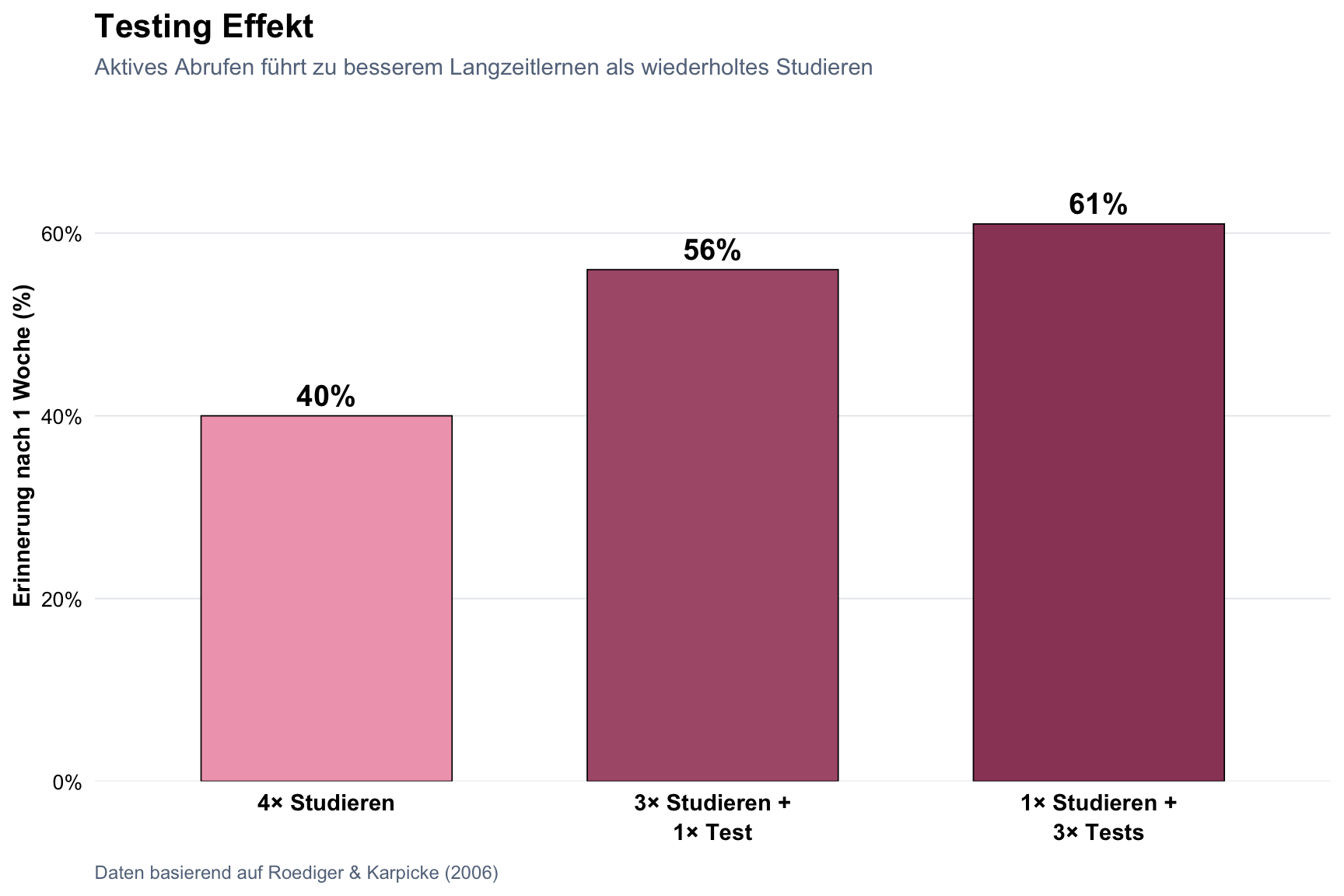
Abrufen ist nicht nur Prüfung, sondern der zentrale Lernmechanismus (Roediger und Butler 2011).
| Befund | Was es bedeutet |
|---|---|
| Abruf > Wiederholung | Abrufpraxis verbessert Behalten stärker als erneutes Studieren |
| Transferfördernd | Abruf aus dem Gedächtnis fördert flexibles Anwenden |
Warum Abrufpraxis funktioniert
Abruf misst Lernen nicht nur, sondern verändert das Gedächtnis (Roediger und Butler 2011).
| Mechanismus | Wirkung |
|---|---|
| Abrufrouten stärken | Wissen wird zugänglicher |
| Lücken identifizieren | Fehlendes Wissen wird sichtbar |
| Elaboration | verwandtes Wissen wird aktiviert |
| Kontext aktualisieren | Wissen wird flexibler abrufbar |
Spacing und Interleaving
Spacing
- Übung über die Zeit verteilen
- teilweises Vergessen vor erneutem Abruf
- wiederholte Konsolidierung
Interleaving
- Aufgabentypen mischen
- passende Strategie auswählen
- Tiefenstrukturen unterscheiden
Elaboration und Generation
Elaboration
- „Warum macht das Sinn?“
- mit Vorwissen verknüpfen
- Beziehungen erklären
Generation
- eigenen Versuch erzeugen
- erst danach die Lösung erhalten
- Versuch mit Rückmeldung vergleichen
Sichtbare Aktivität ist nicht gleich kognitive Aktivität
| Sichtbar | Zu prüfen |
|---|---|
| Gruppendiskussion | Wer ruft Wissen ab und verknüpft Argumente? |
| Gemeinsames Produkt | Wer generiert die Begründung? |
| Präsentation | Wer steuert und überprüft den Lösungsweg? |
| Ausgefüllte Vorlage | Welche Entscheidungen treffen die Studierenden selbst? |
Die Sozialform zeigt nicht, ob jede Person die lernrelevante Verarbeitung ausführt.
Wenn wirksames Lernen sich schwierig anfühlt
Strategien wie Abruf, Spacing und Interleaving können die momentane Leistung senken und zugleich späteres Behalten verbessern (Bjork 1994; Dunlosky u. a. 2013).
Das subjektive Gefühl von Leichtigkeit ist deshalb kein verlässlicher Lernnachweis.
Schwierigkeit ist ebenfalls kein Lernnachweis. Entscheidend ist, welche Verarbeitung sie auslöst und ob diese bewältigbar ist.
Das Lernparadox
| Während der Aktivität | Spätere selbstständige Leistung |
|---|---|
| flüssige Bearbeitung mit viel Unterstützung | kann fehlende Schemata verdecken |
| verlangsamter Abruf oder eigener Versuch | kann Abrufrouten und Schemata aufbauen |
Momentane Leistung und nachhaltiges Lernen müssen getrennt beurteilt werden.
Das Lernparadox: Überblick
Show code
viewof lernparadox_quadrant = {
  const div = html`<div style="display:flex;align-items:center;gap:8px;font-size:13px;">
    <button class="lp-btn" data-step="1" style="padding:4px 12px;border-radius:4px;border:1.5px solid #D55E00;background:#FFF5F0;cursor:pointer;font-size:12px;font-weight:600;color:#D55E00;">1. Illusion</button>
    <button class="lp-btn" data-step="2" style="padding:4px 12px;border-radius:4px;border:1.5px solid #0072B2;background:#F0F7FC;cursor:pointer;font-size:12px;font-weight:600;color:#0072B2;">2. Produktiv</button>
    <button class="lp-btn" data-step="3" style="padding:4px 12px;border-radius:4px;border:1.5px solid #999;background:#F5F5F5;cursor:pointer;font-size:12px;font-weight:600;color:#666;">3. Effizienz</button>
    <button class="lp-btn" data-step="4" style="padding:4px 12px;border-radius:4px;border:1.5px solid #999;background:#F5F5F5;cursor:pointer;font-size:12px;font-weight:600;color:#666;">4. Frustration</button>
    <a href="#" class="lp-reset" style="color:#888;font-size:11px;margin-left:4px;display:none;">Zurücksetzen</a>
  </div>`;
  const btns = div.querySelectorAll(".lp-btn");
  const reset = div.querySelector(".lp-reset");
  div.value = 0;

  let revealed = 0;
  btns.forEach((btn, i) => {
    if (i > 0) btn.style.opacity = "0.4";
    btn.onclick = () => {
      if (i <= revealed) return;
      revealed = i;
      div.value = i + 1;
      btn.style.opacity = "1";
      if (i + 1 < btns.length) btns[i + 1].style.opacity = "1";
      if (i > 0) reset.style.display = "";
      div.dispatchEvent(new Event("input", {bubbles: true}));
    };
  });
  // First button always clickable
  btns[0].onclick = () => {
    if (revealed >= 0 && div.value >= 1) return;
    revealed = 0;
    div.value = 1;
    btns[1].style.opacity = "1";
    div.dispatchEvent(new Event("input", {bubbles: true}));
  };

  reset.onclick = (e) => {
    e.preventDefault();
    revealed = 0;
    div.value = 0;
    btns.forEach((btn, i) => { btn.style.opacity = i === 0 ? "1" : "0.4"; });
    reset.style.display = "none";
    div.dispatchEvent(new Event("input", {bubbles: true}));
  };

  return div;
}
Show code
lernparadox_matrix = {
  const w = 580;
  const h = 400;
  const step = lernparadox_quadrant;

  const blue = "#0072B2";
  const terra = "#D55E00";
  const dark = "#1A1714";

  // Layout
  const ml = 90;   // margin left (axis label)
  const mr = 20;
  const mt = 20;
  const mb = 50;   // margin bottom (axis label)
  const gw = w - ml - mr;  // grid width
  const gh = h - mt - mb;  // grid height
  const cx = ml + gw / 2;  // center x
  const cy = mt + gh / 2;  // center y

  const svg = d3.create("svg")
    .attr("viewBox", `0 0 ${w} ${h}`)
    .attr("width", w)
    .attr("height", h)
    .style("font-family", "'Space Grotesk', sans-serif")
    .style("background", "transparent");

  // Grid lines
  svg.append("line").attr("x1", ml).attr("y1", cy).attr("x2", ml + gw).attr("y2", cy)
    .attr("stroke", "#ccc").attr("stroke-width", 1);
  svg.append("line").attr("x1", cx).attr("y1", mt).attr("x2", cx).attr("y2", mt + gh)
    .attr("stroke", "#ccc").attr("stroke-width", 1);

  // Outer border
  svg.append("rect").attr("x", ml).attr("y", mt).attr("width", gw).attr("height", gh)
    .attr("fill", "none").attr("stroke", "#999").attr("stroke-width", 1.5);

  // Axis labels
  // X axis
  svg.append("text").attr("x", cx).attr("y", h - 8)
    .attr("text-anchor", "middle").attr("fill", dark)
    .attr("font-size", "13px").attr("font-weight", "600")
    .text("Subjektives Gefühl beim Lernen");
  svg.append("text").attr("x", ml + 10).attr("y", mt + gh + 22)
    .attr("text-anchor", "start").attr("fill", "#888")
    .attr("font-size", "11px").text("Schwierig");
  svg.append("text").attr("x", ml + gw - 10).attr("y", mt + gh + 22)
    .attr("text-anchor", "end").attr("fill", "#888")
    .attr("font-size", "11px").text("Leicht");

  // Y axis
  svg.append("text").attr("x", 14).attr("y", cy)
    .attr("text-anchor", "middle").attr("fill", dark)
    .attr("font-size", "13px").attr("font-weight", "600")
    .attr("transform", `rotate(-90, 14, ${cy})`)
    .text("Tatsächliches Lernen");
  svg.append("text").attr("x", ml - 10).attr("y", mt + gh - 5)
    .attr("text-anchor", "end").attr("fill", "#888")
    .attr("font-size", "11px").text("Wenig");
  svg.append("text").attr("x", ml - 10).attr("y", mt + 15)
    .attr("text-anchor", "end").attr("fill", "#888")
    .attr("font-size", "11px").text("Viel");

  // Quadrant definitions
  const quadrants = [
    // 1: Bottom-right — Illusion des Lernens
    {
      x: cx, y: cy, w: gw/2, h: gh/2,
      fill: "#D55E0018", title: "Illusion des\nLernens",
      titleColor: terra, annotation: "Metakognitive Falle",
      annotColor: terra, step: 1
    },
    // 2: Top-left — Produktive Anstrengung
    {
      x: ml, y: mt, w: gw/2, h: gh/2,
      fill: "#0072B218", title: "Produktive\nAnstrengung",
      titleColor: blue, annotation: "ZIEL",
      annotColor: blue, step: 2
    },
    // 3: Top-right — Experten-Effizienz
    {
      x: cx, y: mt, w: gw/2, h: gh/2,
      fill: "#0072B20C", title: "Experten-\nEffizienz",
      titleColor: "#5599BB", annotation: "OK für Fortgeschrittene",
      annotColor: "#888", step: 3
    },
    // 4: Bottom-left — Unproduktive Frustration
    {
      x: ml, y: cy, w: gw/2, h: gh/2,
      fill: "#D55E000C", title: "Unproduktive\nFrustration",
      titleColor: "#CC8866", annotation: "Vermeiden",
      annotColor: "#888", step: 4
    },
  ];

  for (const q of quadrants) {
    if (step < q.step) continue;

    const g = svg.append("g");

    // Background
    g.append("rect")
      .attr("x", q.x).attr("y", q.y)
      .attr("width", q.w).attr("height", q.h)
      .attr("fill", q.fill);

    // Title (centered in quadrant)
    const qcx = q.x + q.w / 2;
    const qcy = q.y + q.h / 2 - 10;
    const lines = q.title.split("\n");
    lines.forEach((line, i) => {
      g.append("text")
        .attr("x", qcx).attr("y", qcy + i * 22 - (lines.length - 1) * 11)
        .attr("text-anchor", "middle")
        .attr("fill", q.titleColor)
        .attr("font-size", "18px")
        .attr("font-weight", "bold")
        .text(line);
    });

    // Annotation (below title)
    g.append("text")
      .attr("x", qcx).attr("y", qcy + lines.length * 22 - (lines.length - 1) * 11 + 4)
      .attr("text-anchor", "middle")
      .attr("fill", q.annotColor)
      .attr("font-size", "11px")
      .attr("font-style", "italic")
      .text(q.annotation);
  }

  // Curve (shown after step 2: from top-left to bottom-right)
  if (step >= 2) {
    const curvePoints = [];
    for (let t = 0; t <= 1; t += 0.02) {
      // Sigmoid-like curve from top-left to bottom-right
      const px = ml + gw * 0.15 + gw * 0.7 * t;
      const py = mt + gh * 0.2 + gh * 0.6 * (1 / (1 + Math.exp(-6 * (t - 0.5))));
      curvePoints.push([px, py]);
    }
    const line = d3.line().curve(d3.curveBasis);
    svg.append("path")
      .attr("d", line(curvePoints))
      .attr("fill", "none")
      .attr("stroke", "#9A4665")
      .attr("stroke-width", 2.5)
      .attr("opacity", 0.7);
  }

  return svg.node();
}
Verarbeitungsflüssigkeit beschreibt, wie leicht sich eine Aktivität momentan anfühlt.
Sie ist kein verlässlicher Indikator für späteres Behalten oder selbstständige Anwendung.
Bibliographie
Bjork, Robert A. 1994. „Memory and Metamemory Considerations in the Training of Human Beings“. In Metacognition: Knowing about Knowing. The MIT Press. https://doi.org/10.7551/mitpress/4561.001.0001.
Dunlosky, John, Katherine A. Rawson, Elizabeth J. Marsh, Mitchell J. Nathan, und Daniel T. Willingham. 2013. „Improving Students’ Learning With Effective Learning Techniques: Promising Directions From Cognitive and Educational Psychology“. Psychological Science in the Public Interest, Online-Vorab-Publikation, Januar 8. https://doi.org/10.1177/1529100612453266.
Roediger, Henry L., und Andrew C. Butler. 2011. „The Critical Role of Retrieval Practice in Long-Term Retention“. Trends in Cognitive Sciences 15 (1): 20–27. https://doi.org/10.1016/j.tics.2010.09.003.