Workshop: Global Management

Andrew Ellis

27 June, 2024

Contents

  • What are LLMs?
  • Understanding LLM capabilities and limitations
  • Fundamentals of prompting
  • Break
  • LLMs in the classroom
  • Essential skills
  • Academic integrity
  • Conclusion

Guide for Lecturers at BFH

  • BFH’s Stance: Technologies that support the learning process and are relevant in practice should be integrated into teaching.
  • Use of AI in Teaching: The majority of students will use AI tools. Students should learn to use technologies competently and to critically question them.


Virtual Academy Knowledge Base [more up-to-date than PDF]

PDF

What are Large Language Models (LLMs)?

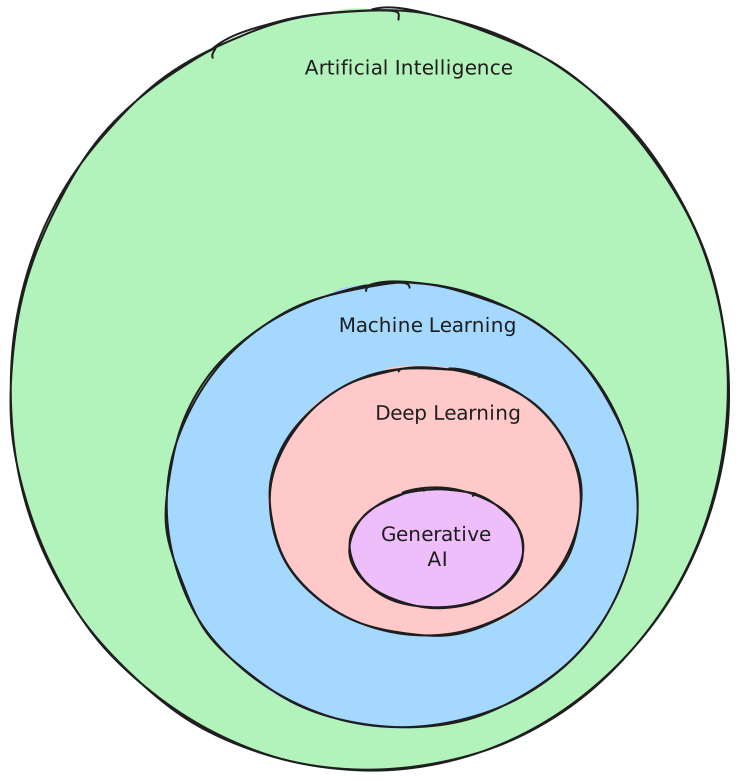
What is Artifical Intelligence?

A branch of computer science that aims to create machines that can perform tasks that typically require human intelligence.

What is a Large Language Model?
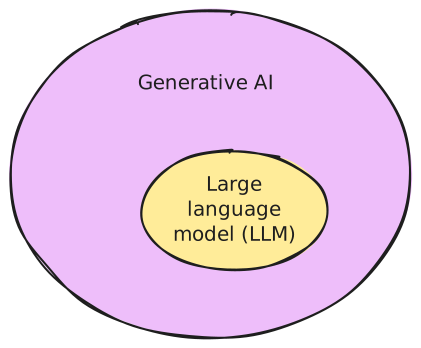
An LLM is a type of generative AI model that is trained to predict the next word following the input (prompt).

How to train a language model

  • An LLM learns to predict the next word in a sequence, given the previous words: \[ P(word | context) \]
  • Think of as “fancy autocomplete” (but very very powerful and sopisticated)

How does an LLM generate text?
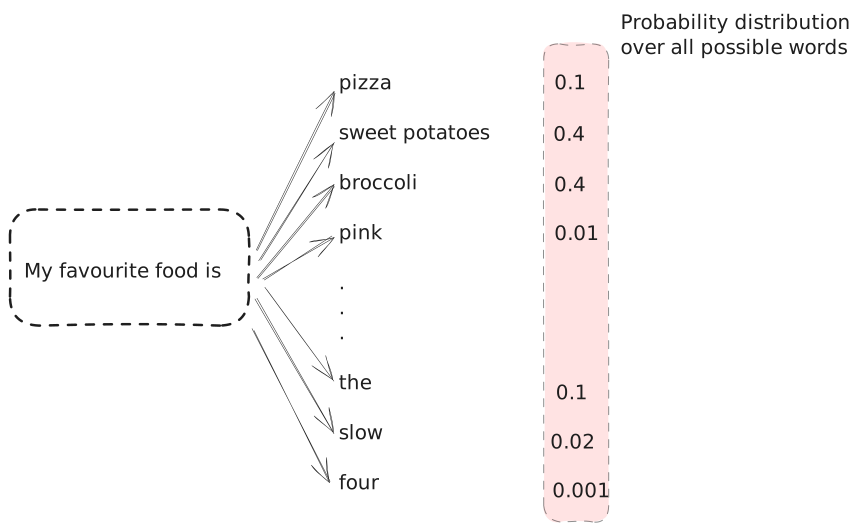
Sampling
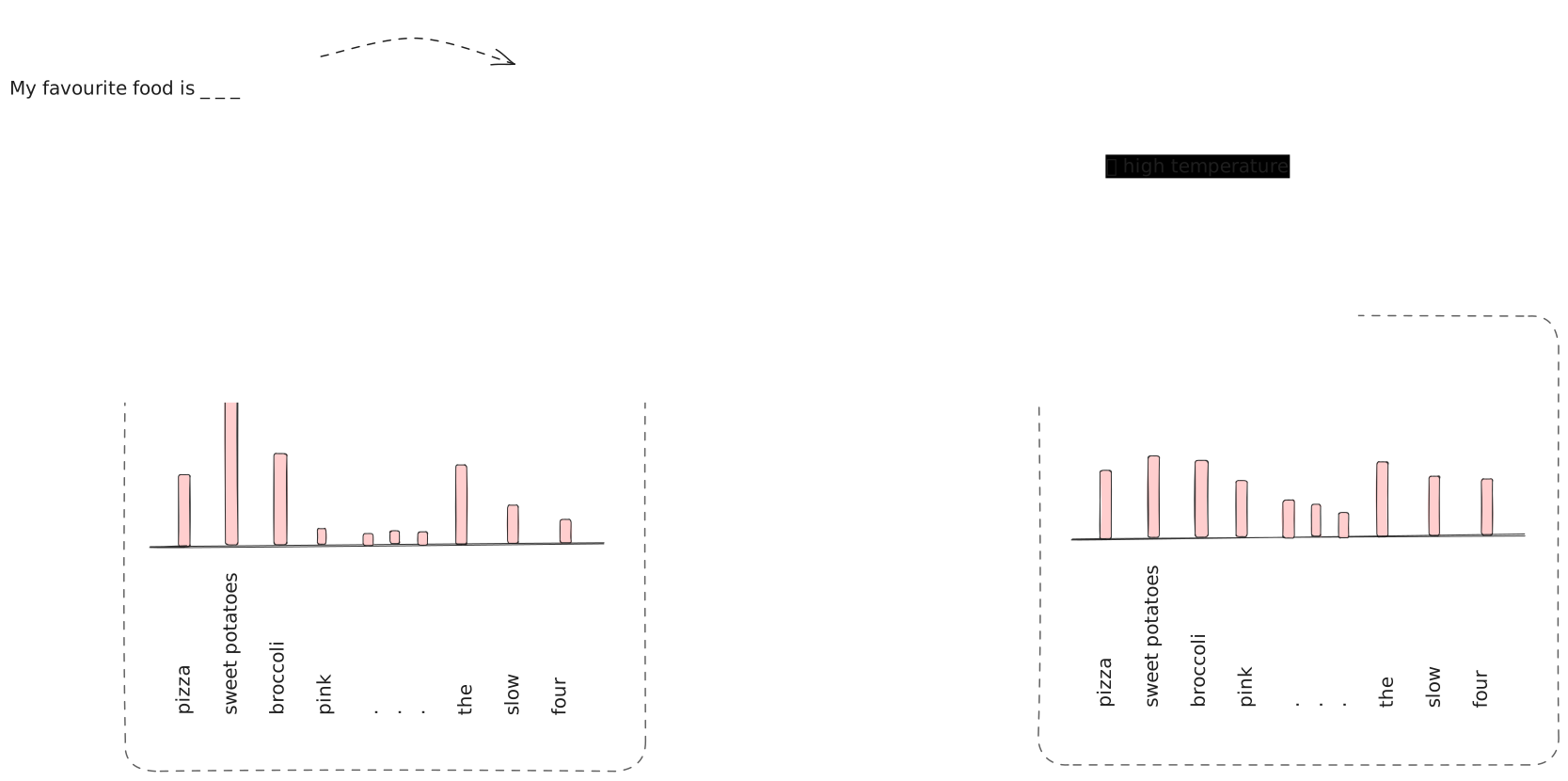
Auto-regressive generation

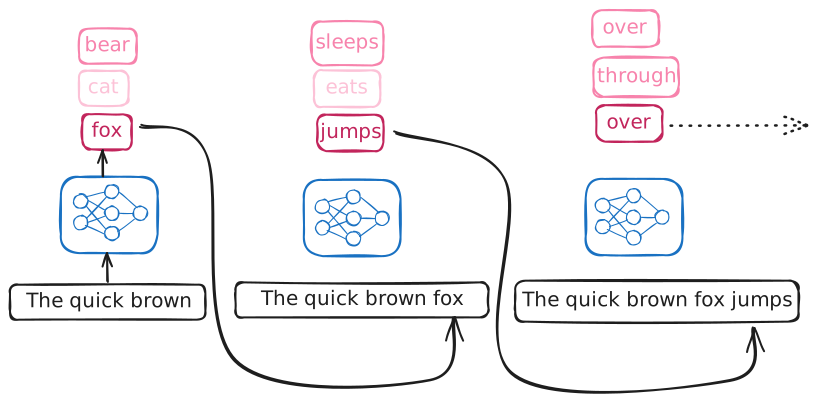
Text is generated one word at a time (actually tokens, not words).
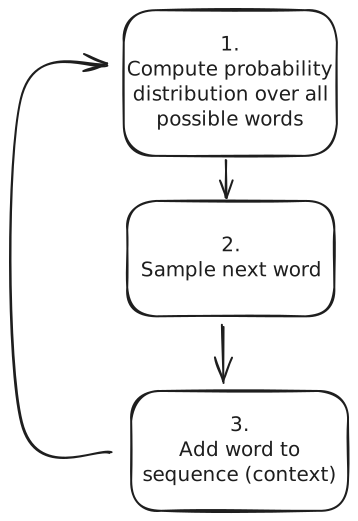
Generated text depends on the generative model and the context.

Every word (token) is given an equal amount time (computation per token is constant).

Auto-regressive generation
Foundation models

A foundation model, or large language model (LLM):

  • is a type of machine learning model that is trained to predict the next word following the input (prompt).
  • is trained “simply” to predict the next word following a sequence of words.
  • does not necessarily produce human-like conversations.

: What is the capital of France?

: What is the capital of Germany? What is the capital of Italy? . ..

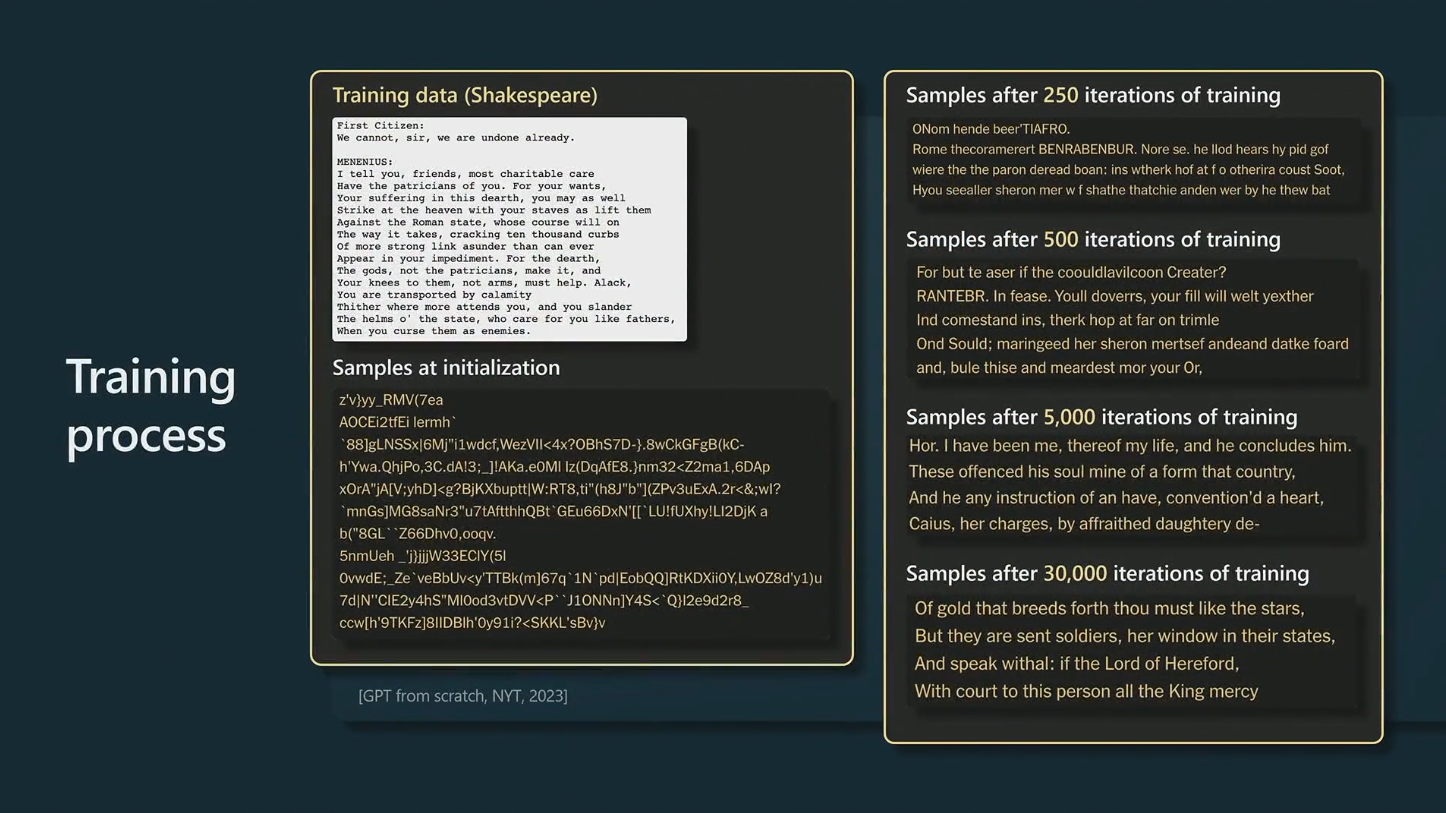
Training process

Figure courtesy of Andrej Karpathy

Assistant models

Trained (fine-tuned) to have conversations: turn-taking, question answering, not being rude/sexist/racist.

  • Foundation model has learned to predict all kinds of text, including both desirable and undesirable text.
  • Fine-tuning narrows down the space of all possible output to only desirable, human-like dialogue.
  • Model is aligned with the values of the fine-tuner.

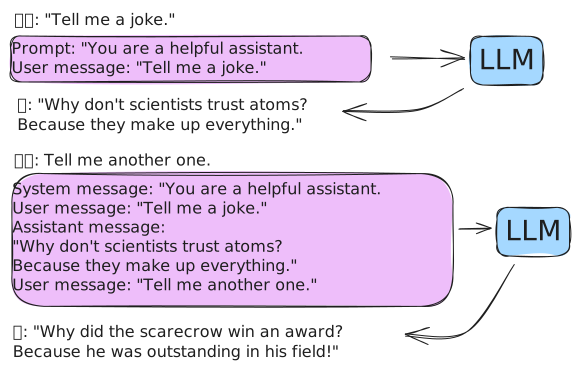
How do Chatbots work?

  • Designed to present the illusion of a conversation between two entities.

How do chatbots actually work?
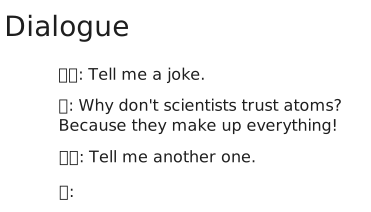
An assistant model is a conversation simulator

  • An assistant is trained to respond to user prompts in a human-like way.
  • Simulates possible human conversations.
  • Has no intentions. It is not an entity with its own goals.
  • Does not have a “personality” or “character” in the traditional sense. It can be thought of as a role-playing simulator.
  • Has no concept of “truth” or “lying”. The model is not trying to deceive the user, it is simply trying to respond in a human-like way.

Understanding LLM capabilities and limitations

Capabilities and limitations

What are LLMs good at?

  • Fixing grammar, bad writing, etc.
  • Rephrasing
  • Analyzing texts
  • Writing computer code
  • Answering questions about a knowledge base
  • Translating languages
  • Creating structured output
  • Factual output with external documents or web search

Limitations

  • They make stuff up (hallucinate)
  • They learn biases from the training data
  • Weird vocabulary, e.g. delve
  • (Chatbots have privacy issues)

Hallucination

  • LLMs can generate text that is not true, or not based on any real-world knowledge.
  • This is known as “hallucination”. A better term would be “confabulation”.

Can an LLM tell the truth?

  • How would you know if an LLM is able to give you factual information?
  • How would you test this?

: What is the capital of Uzbekistan?

: Tashkent

It looks like the LLM knows the capital of Uzbekistan1.

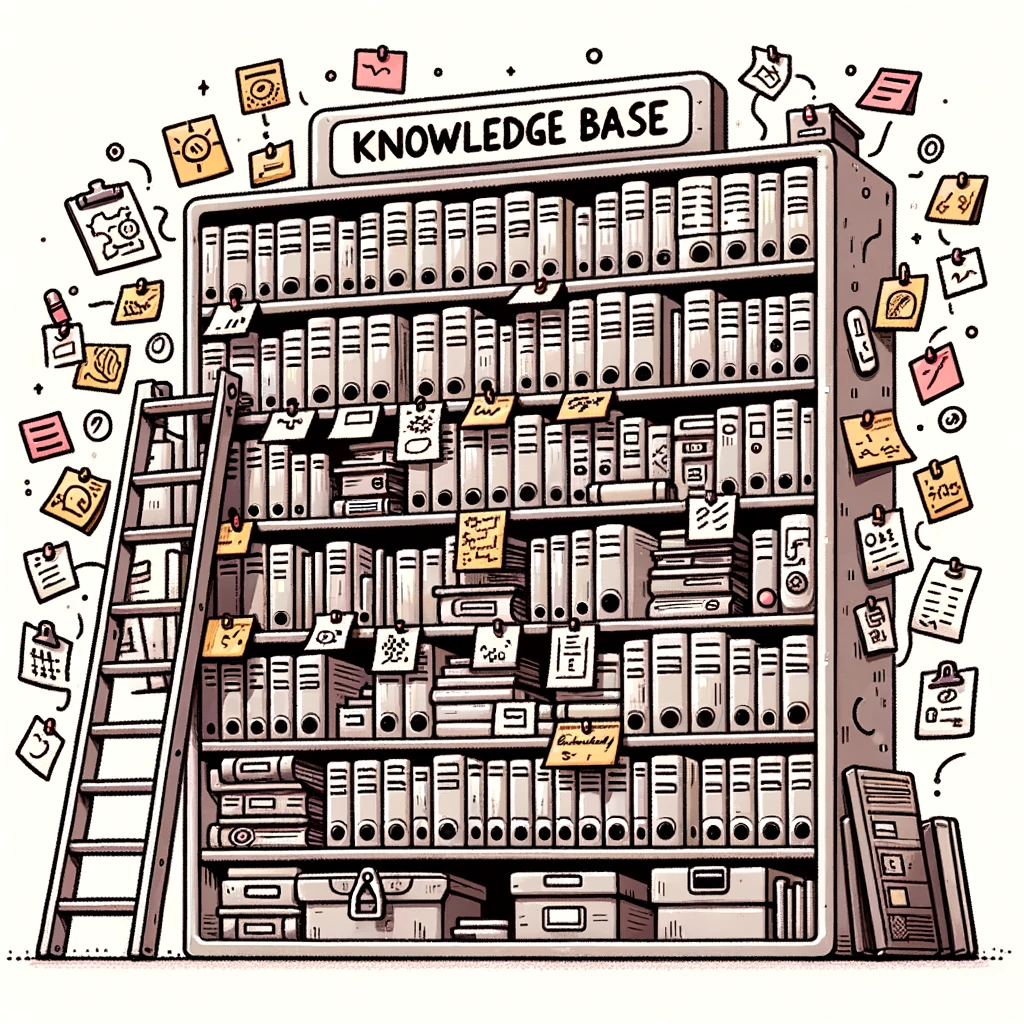
Knowledge base

  • A knowledge base is a collection of facts about the world.
    • You can ask (retrieve) and tell (store) facts.
  • An LLM is not a knowledge base.
    • LLMs generate text based on on how probable the next word is given the context, not based on stored facts.
Biases

Biases in LLMs Source Examples
Training data bias Text from internet, books, articles. Stereotypes reflecting gender, race, religion.
Representation bias Underrepresented groups/perspectives in data. Less accurate responses for minority cultures.
Algorithmic bias Training and fine-tuning algorithms. Optimizations for fluency and coherence may lead to preference for dominant cultural narratives.
User interaction bias Adaptation based on user interactions. Increased biased or harmful content generation.

Privacy concerns

Privacy Concerns Issue Examples
Data memorization Memorizing sensitive information. Reproducing phone numbers, addresses.
Training data leakage Unauthorized dissemination of confidential data. Summarizing proprietary documents.
User query logging Storing sensitive user interactions. Exposing private queries if data is mishandled.
Queries used for training User queries may be used for further training. Personal data in queries could be inadvertently included in training data.

Fundamentals of Prompting

Prompting


What is a prompt?

  • An LLM’s task is to complete text.
  • A prompt is a piece of text (instruction) that is given to a language model to complete.

PROMPT : Write a haiku about a workshop on large language models.

ASSISTANT : Whispers of circuits,
Knowledge blooms in bytes and bits,
Model learns and fits.

  • The response is generated as continuation of, and conditioned on, the prompt.

Prompt engineering

  • LLMs learn to do things they were not explicitly trained to do: translation, reasoning, etc.
  • Often, these capabilities need to be “unlocked” by the right prompt.
  • But what is the right prompt?
  • The answer is very similar to what you would tell a human dialogue partner/assistant.
  • You can increase the probability of getting the desired output by providing context and examples.

Basics of prompting

OpenAI give a set of strategies for using their models effectively:

Prompt engineering

These include:

  • writing clear instructions
  • providing reference texts
  • splitting tasks into subtasks
  • giving the LLM ‘time to think’
  • using external tools

Writing clear instructions

Adopt a persona (role)

: You are an expert on learning techniques. Explain the concept of ‘flipped classroom’ in one paragraph.

: You are an expert financial derivatives. Explain the concept of ‘flipped classroom’ in one paragraph.

Provide reference texts

  • Provide a model with trusted and relevant information.
  • Then instruct the model to use the provided information to compose its answer.

Instruct the model to answer using a reference text

Create structured output

  • Explanation: Instruct the model to generate structured output.
  • E.g. provide a table, a list, a diagram, etc.
  • Use delimiters to indicate distinct parts of the input.
  • Example: Extract information from a text and present it in a table.

Structured prompting techniques

  • In-Context Learning: Provide examples within the prompt.
  • Thought Generation: Instruct the model to think step-by-step.
  • Decomposition Techniques: Break down tasks into subtasks.

(Schulhoff et al. 2024)

In-Context learning

  • Explanation: Providing examples or context within the prompt itself.
  • Few-shot prompting: Give a few examples.
    • Example: Translate the following sentences:
      • English: ‘What time is it?’ -> French: ‘Quelle heure est-il?’
      • English: ‘Where is the library?’ -> French:
  • Zero-shot prompting: No examples, relies on pre-trained knowledge.
    • Example: Translate the following sentence…

Thought generation

  • Explanation: Encourages the model to show its reasoning process.
  • Chain-of-Thought (CoT) prompting: encourages the LLM to “explain” its intermediate reasoning steps.
  • Can often be induced by simply instructing the model to think step-by-step or Take a deep breath and work on this problem step-by-step (Yang et al. 2023).

Chain-of-Thought example

Instead of this:

: The odd numbers in this group add up to an even number: 4, 8, 9, 15, 12, 2, 1. Yes or no?

Do this:

: Is this statement correct? The odd numbers in this group add up to an even number: 4, 8, 9, 15, 12, 2, 1.

Reason through the problem step-by-step. Start by identifying the odd numbers. Next, add them up. Finally, determine if the sum is even or odd. Write down your reasoning steps in a numbered list.

Decomposition techniques

  • Explanation: Force the LLM to break down complex tasks into manageable subtasks.
  • Least-to-Most Prompting: Start simple, increase complexity.
    • Example: List items, calculate cost…
  • Plan-and-Solve Prompting: Separate planning and execution phases.
    • Example: Understand the problem, devise a plan…

Hands-on practice: Prompting

Open this activity.

  1. Practice writing prompts for different tasks ( 20 minutes).
  2. Write an essay using an LLM, and then critique someone else’s essay ( 30 minutes).


If you need further help with prompting techniques, see these websites:

LLMs in the Classroom

ChatGPT Edu


  • Access to GPT-4o, excelling in text interpretation, coding, and mathematics
  • Data analytics, web browsing, and document summarization
  • Build GPTs, custom versions of ChatGPT, and share them within university workspaces
  • Significantly higher message limits than the free version of ChatGPT
  • Improved language capabilities across quality and speed, with over 50 languages supported
  • Robust security, data privacy, and administrative controls
  • Conversations and data are not used to train OpenAI models

GPTs

Hands-on practice: GPTs

  1. Try out custom GPTs from various categories in the GPT store.
  2. Discuss with your neighbour
    1. Did you discover any useful GPTs?
    2. What are the benefits and limitations of using GPTs in the classroom?

Extended cognition

  • According to Clark and Chalmers (1998), cognitive processes may extend to external objects.
  • Krakauer (2016) distinguishes between complementary and competitive cognitive artifacts.
    • Complementary: numbers, abacus
    • Competetive: calculator, GPS
  • What kind of artefact will AI turn out to be?

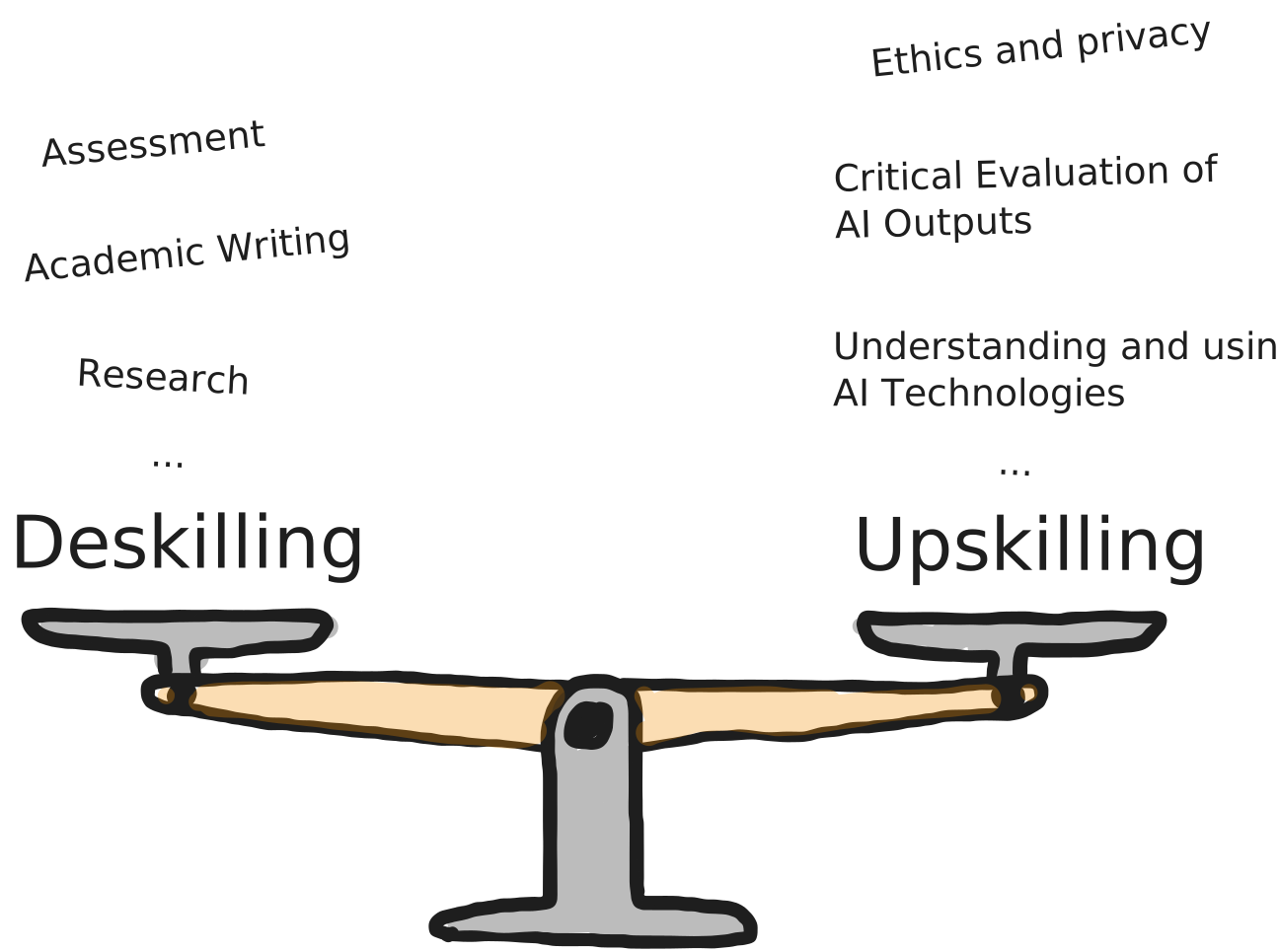
Deskilling vs. upskilling

Writing tasks in the AI era

  • Writing is a core skill: critical thinking, persuasion, argumentation, understanding.
  • Text creation is secondary in learning: focus is on underlying skills.
  • Learning objectives: Benefits of writing tasks should be clearly and convincingly conveyed.
  • Students should be equipped for effective (controlled) use of AI.

AI can do my homework

  • We can think of this as cheating.
  • More useful: cheating means bypassing useful cognition and therefore missing out on learning.
  • Cheating an ethics problem.
  • Bypassing cognition is a learning problem.
  • Not a new problem: books, encyclopedias, calculators, spell checkers, etc.

Controlled use of LLMs

Task Category Specific Tasks
Editing tasks Create/improve different versions of sections.
Transitions Write and compare transitions.
Improve drafts Critique and refine drafts.
Writing styles Rewrite sections for different audiences.
Controversial statements Identify controversial points and strengthen arguments.
Research journal Keep a diary and use LLM for reflection.

Sport vs. writing

  • Technological advancements in sports: a useful analogy for learning?
  • Distinction between training and competition.

LZR Racer swim suit AI-base writing tools
Improvement Reduced Resistance, Increased Buoyancy Improved Grammar, Formulation, Content Creation
Fairness Provided an Unfair Advantage, Led to Record Performances Considered Unfair in Academic Contexts
Impact Banned to Maintain Competitive Integrity Raises Questions of Originality and Skill Development

Learning Environments

Understanding the value of effort

  • Cheating can be a symptom that learners do not understand or value the importance of their own work.
  • Just like in sport: if we take shortcuts during training, we won’t get fit.
  • Understanding the purpose is important to endure discomfort.
  • Learners need to understand what they are supposed to learn, why it is valuable, and why effort and discomfort are necessary.

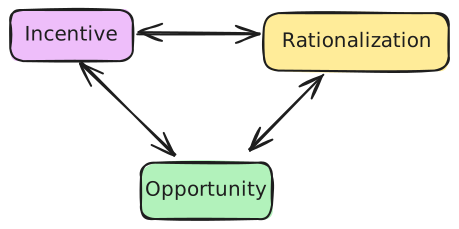
Fraud triangle

Learning Environments that promote cheating

Factors Descriptions
High pressure High stakes increase cheating. Fear of failure reinforces this.
Lack of intrinsic motivation Engagement and relevance are important. Lacking these makes cheating more attractive.
Perceived injustice Unfair grading leads to cheating.
Low fear of getting caught Low risk encourages cheating.
Peer influence Widespread cheating among peers pressures students to join in.
Low self-efficacy Doubts about one’s own abilities increase cheating as the seemingly only option.

Strategies to Reduce Cheating

Strategies Descriptions
Foster intrinsic motivation Spark genuine interest. Provide choices and practical applications.
Mastery learning Clear learning objectives. Focus on mastery of content. Include constructive and corrective feedback in formative assessments.
Reduce pressure Diversify assessment methods. Use portfolios and low-stress tests to reduce anxiety.
Strengthen self-efficacy Provide constructive feedback and promote peer learning (peer tutoring, peer review).
Create a culture of integrity Open discussion about academic integrity. Set clear guidelines and promote community ethics.

Academic integrity

Academic Integrity: Plagiarism

Types of Plagiarism Description
Unattributed use Using the work or ideas of others without proper attribution.
Minor changes or translations Using the work of others with minor changes or translations without attribution.
Self-plagiarism Reusing substantial parts of one’s own work without proper citation.
Joint works Reusing jointly written publications without proper acknowledgment.

Academic Integrity: Misconduct in authorship

Types of Plagiarism Description
Unattributed use Using the work or ideas of others without proper attribution.
Minor changes or translations Using the work of others with minor changes or translations without attribution.
Self-plagiarism Reusing substantial parts of one’s own work without proper citation.
Joint works Reusing jointly written publications without proper acknowledgment.

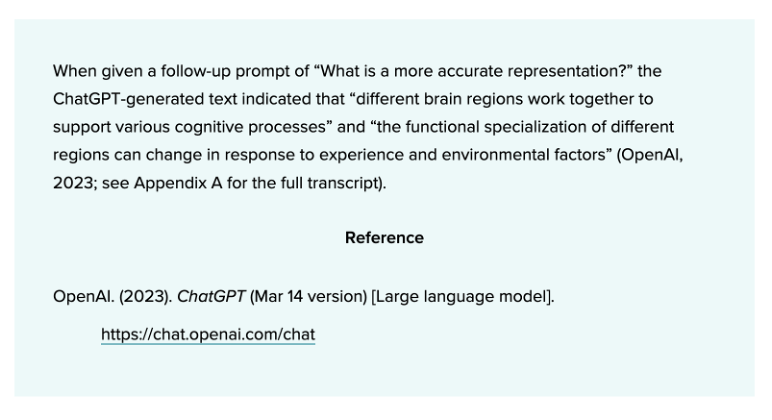
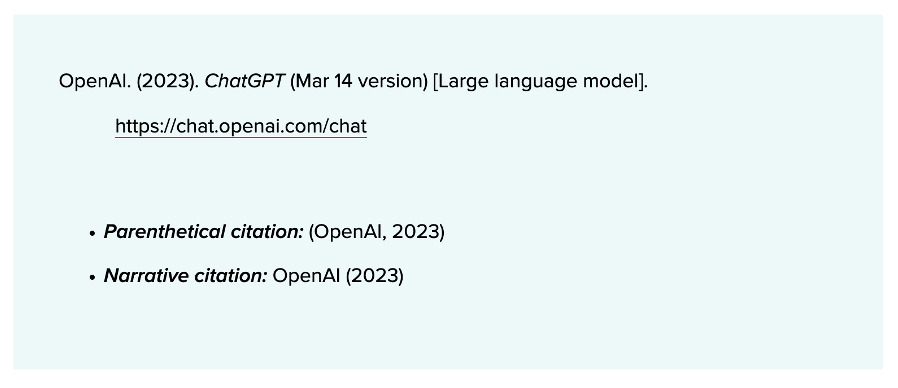
How to cite ChatGPT

E.g. APA Style: Cite as software (not as personal communication).


Documentating AI use

  • Specifying prompts works well for inexperienced users, but inadequately reflects complex processes.
  • Experienced users work with dialogues and several tools, not monolithic prompts in ChatGPT.
  • Working with copilot (code): no traceable prompt input.
  • Instead: Document the process, including the tools used and the steps taken.
    • Include used tools and steps in appendix, with optional graphical representation.
    • Serves both evaluation and self-reflection.
  • Is documentation meaningful in the long term, once the use of AI-based tools has become commonplace?

Detecting AI use

  • Can be detected by the use of specific vocabulary and phrases: “delve”, “vibrant”, “embark”, “it’s important to note”, ” based on the data provided”.

  • Detection tools are not very useful, and can be easily circumvented.

  • According to Fleckenstein et al. (2024)

    • Generative AI can write papers that are undetectable.
    • Teachers overestimate their detection abilities.

Questions / Discussion

References

Bowen, José Antonio, and C. Edward Watson. 2024. Teaching with AI. Johns Hopkins University Press. https://doi.org/10.56021/9781421449227.
Clark, Andy, and David Chalmers. 1998. “The Extended Mind.” Analysis 58 (1): 7–19. https://www.jstor.org/stable/3328150.
Fleckenstein, Johanna, Jennifer Meyer, Thorben Jansen, Stefan D. Keller, Olaf Köller, and Jens Möller. 2024. “Do Teachers Spot AI? Evaluating the Detectability of AI-generated Texts Among Student Essays.” Computers and Education: Artificial Intelligence 6 (June): 100209. https://doi.org/10.1016/j.caeai.2024.100209.
Krakauer, David. 2016. “Will A.I. Harm Us? Better to Ask How We’ll Reckon With Our Hybrid Nature.” Nautilus. September 6, 2016. https://nautil.us/will-ai-harm-us-better-to-ask-how-well-reckon-with-our-hybrid-nature-236098/.
Lang, James M. 2013. “Cheating Lessons.” Harvard University Press. 2013. https://www.hup.harvard.edu/books/9780674724631.
Schulhoff, Sander, Michael Ilie, Nishant Balepur, Konstantine Kahadze, Amanda Liu, Chenglei Si, Yinheng Li, et al. 2024. “The Prompt Report: A Systematic Survey of Prompting Techniques.” June 6, 2024. http://arxiv.org/abs/2406.06608.
Yang, Chengrun, Xuezhi Wang, Yifeng Lu, Hanxiao Liu, Quoc V. Le, Denny Zhou, and Xinyun Chen. 2023. “Large Language Models as Optimizers.” September 6, 2023. http://arxiv.org/abs/2309.03409.